Enters instantly
130 to 170 litres per minute per square metre through 20 to 26 per cent voids, measured at 9,400 mm per hour by VicRoads.

Most pages tell you the concrete is permeable and stop there. The question that decides your job is what happens to the water after it disappears: how fast it enters, where it sits, and what leaves your site in a real downpour. This page follows it from the raindrop to the subgrade.
The slab is the doorway, not the destination. Permcon is a no-fines mix with 20 to 26 per cent interconnected voids, so rain enters the surface wherever it lands rather than running sideways to a grate. Under VicRoads testing the surface took water at 9,400 millimetres per hour. In the units estimators use on site, that is 130 to 170 litres per minute through every square metre, which is far more than any storm can deliver.
Below the slab is the part that does the stormwater work. We build an open-graded stone base and design it as a reservoir, typically holding 28 to 56 litres of water per square metre in the gaps between the stones. That is your detention, already inside the pavement, taking the peak off the storm instead of sending it to the kerb in the first ten minutes.
From there the water has somewhere to go. On free-draining ground it infiltrates into the subgrade and recharges the soil. Where the ground is tight clay, or infiltration is not permitted, we line the base and run a slow controlled outlet, so the pavement still detains and filters even when it cannot soak away. Either way the runoff coefficient sits around 0.3, and roughly 70 per cent of pollutants are trapped in the profile rather than washed into the drain.
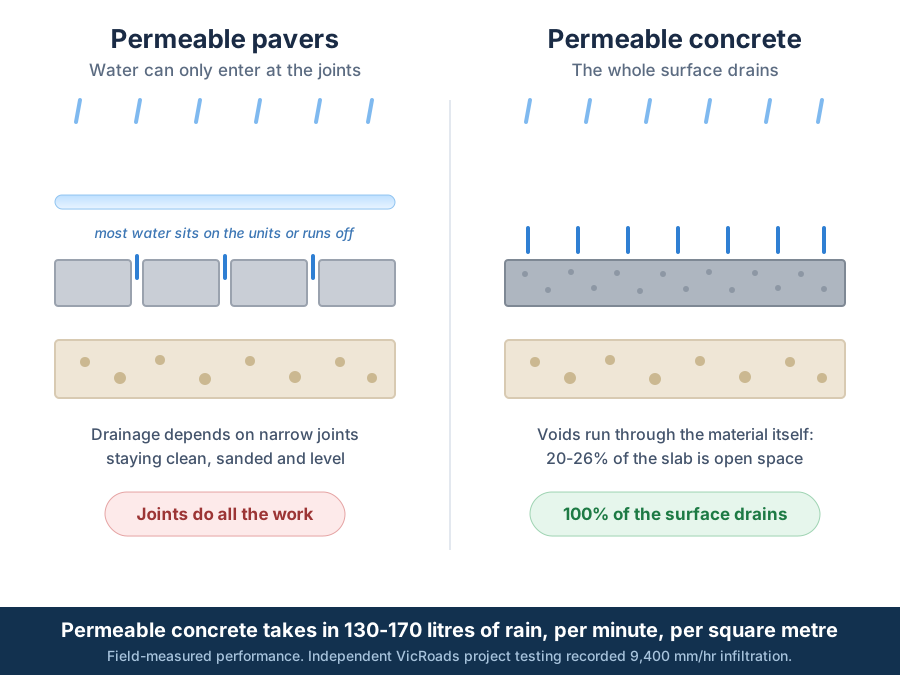
The surface takes in 130 to 170 litres of rain per minute, per square metre, through voids that run through the material itself, 20 to 26 per cent of the slab by volume. Independent testing on a VicRoads project measured 9,400 millimetres per hour.
Below the slab, an open-graded stone base stores the water and lets it soak or release at a controlled rate, holding 28 to 56 litres per square metre inside the system.
A few quick questions about your site. You get a straight answer about whether permeable concrete is the right call, including when it isn't, before anyone asks for your details.
Get in touch today to discuss your project. We're here to help with all your permeable concrete requirements, from a single driveway to major civil infrastructure.
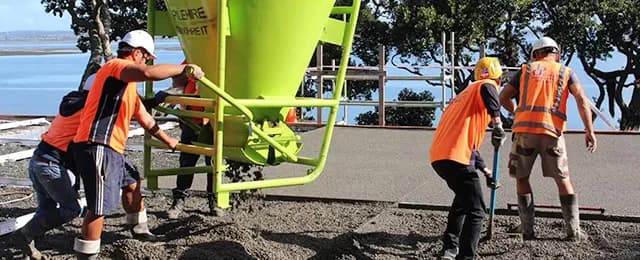
130 to 170 litres per minute per square metre through 20 to 26 per cent voids, measured at 9,400 mm per hour by VicRoads.
An open-graded base built as a reservoir holding 28 to 56 litres per square metre before anything needs to leave.
A runoff coefficient around 0.3 means most of the rain never reaches the stormwater system as fast runoff.
About 70 per cent of pollutants and sediment are caught in the profile instead of ending up in the creek.
Where the subgrade will not take water we line the base and meter the discharge, keeping the detention and the filtering.
Water leaves the surface where it lands, so there is nothing standing to freeze, sheet or splash.
Water permeable concrete, also called no-fines, pervious or porous concrete, is made from cement, water and coarse aggregate with little or no sand. Removing the fines leaves a matrix of interconnected voids running through the hardened material, typically 20 to 26 per cent of the volume as placed, against three to five per cent in conventional concrete. Those voids are continuous, which is the point. Water does not soak into the material and stop, it passes straight through and out the bottom.
Getting there is a paste-coating exercise. Enough cement paste to coat every aggregate particle and lock the matrix together, not so much that it runs down and seals the voids at the base of the slab. That balance is the reason we design and manufacture the mix ourselves rather than buying a generic pour, and why we run 7 mm aggregate in Victoria and Tasmania and 10 mm in New South Wales, Queensland, South Australia and Western Australia. This page is the water-focused deep dive; for the product overview, finishes and applications, start at our main permeable concrete page.
Infiltration is quoted two ways and both describe the same behaviour. As a depth rate, our surface was measured at 9,400 millimetres per hour under VicRoads testing. As a volume rate, that is 130 to 170 litres per minute through each square metre. For context, no rainfall event in Australia comes close to those figures, which is why a correctly built permeable pavement does not pond even under the heaviest downpour. The practical consequence is that the surface stops being the bottleneck, and the design conversation moves to storage and discharge.
Under the slab we build an open-graded stone base and treat it as a storage layer. Depending on depth and stone grading, it typically holds 28 to 56 litres of water per square metre in the void space between the particles. On a modest car park that is a serious volume of detention with no tank, no pit and no pump. The stored water then either infiltrates into the subgrade, which we can usually work with directly at CBR 5 and above, or is released through a metered outlet where the ground or the approval will not allow infiltration.
The whole system typically returns a runoff coefficient around 0.3, and traps roughly 70 per cent of the pollutants carried in the first flush: sediment, hydrocarbons and the fine grit that otherwise ends up in the waterway. That combination of detention, infiltration and filtering is why permeable paving is a recognised water sensitive urban design asset rather than just a surface finish.
The only thing that stops water permeable concrete draining is clogging, and clogging is preventable. Edge the pavement so unstabilised soil cannot wash across it, keep landscape runoff off the surface, stabilise upstream ground during construction, and schedule a vacuum sweep. If capacity has already dropped, a pressure wash followed by vacuuming recovers most of it. Do this and the surface meets its 30 year plus design life while still carrying 20 to 25 MPa trafficable loading to AS 3727.1 and a P4 slip rating.
Send us the area, the soil and what your council is asking for, and an estimator will work through the intake, the storage and the discharge for your actual job. Call 1300 010 499 or book a free on-site assessment.