Residential Driveway Project
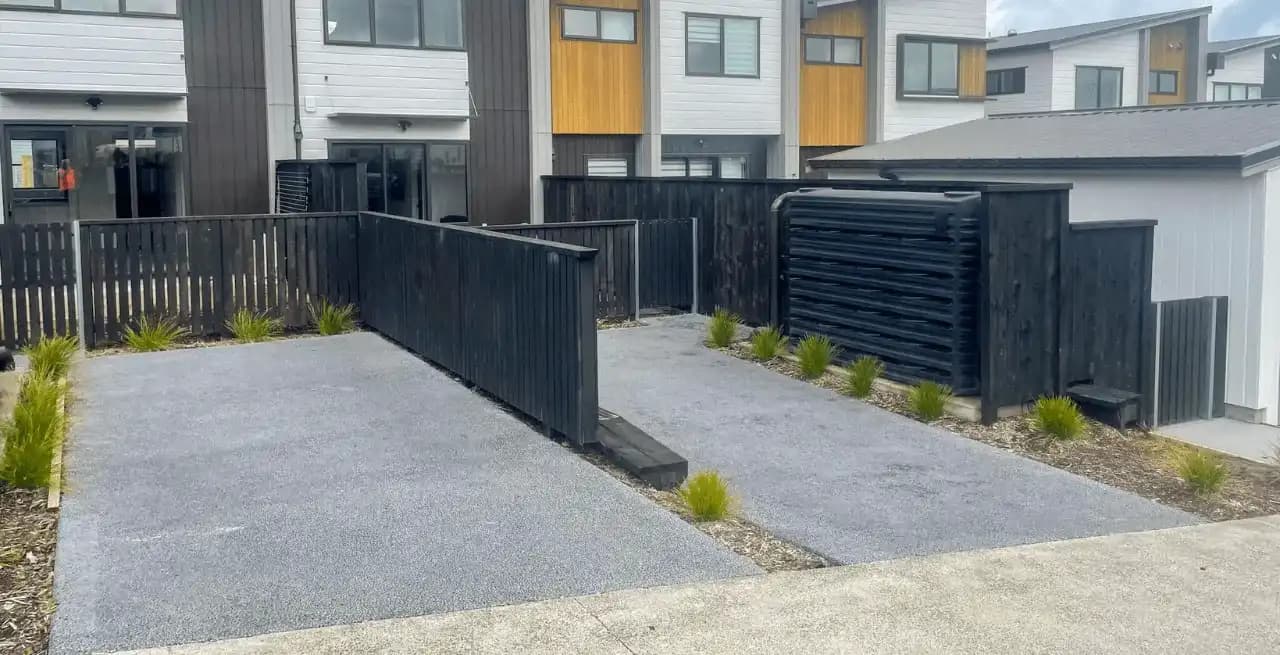
Split down the middle by a black timber fence, two plain grey permeable parking pads front a contemporary home and finish at garden beds on each side.
Rain goes down through the slab where it falls, instead of racing to the kerb. Many councils count a Permcon driveway toward the permeable area on your permit. We have installation teams in every state.
Prefer to talk? Call 1300 010 499
Had my driveway extended and a slab of concrete installed by APC and they did an excellent job. They were easy to deal with from start to finish. Unlike many others who don't even bother coming out to quote.
Can't fault the service they provide. The workmanship and care that the boys take when it comes to prepping and pouring is outstanding.
The price was on budget and we're very happy with the finished product.
A few quick questions about your site. You get a straight answer about whether permeable concrete is the right call, including when it isn't, before anyone asks for your details.
A rough answer is fine. We confirm it on site.
 Permcon™ is Australian made. Designed at our Mitcham factory, mixed with Boral Concrete and poured by our own crewsAbout our manufacturing
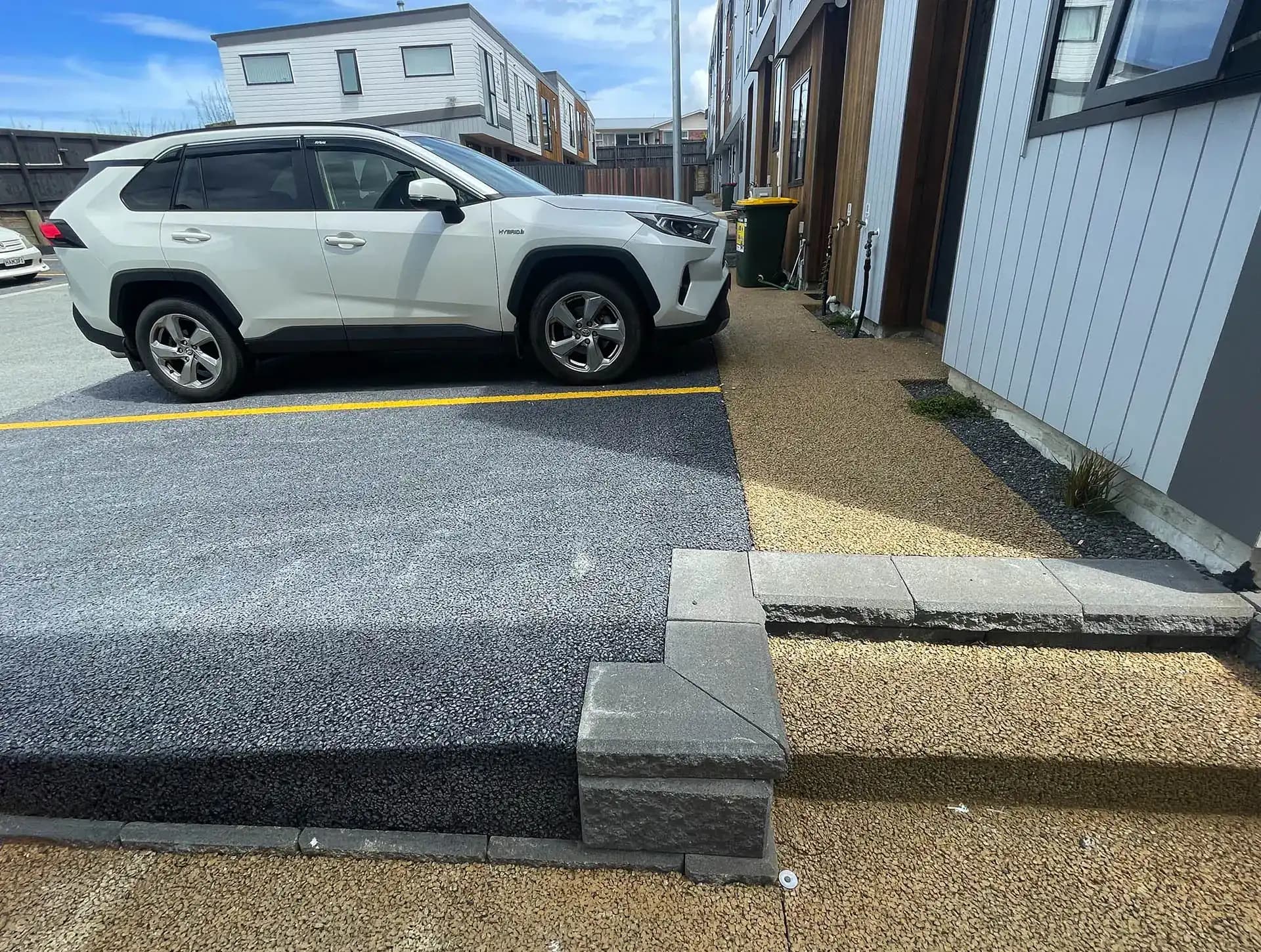
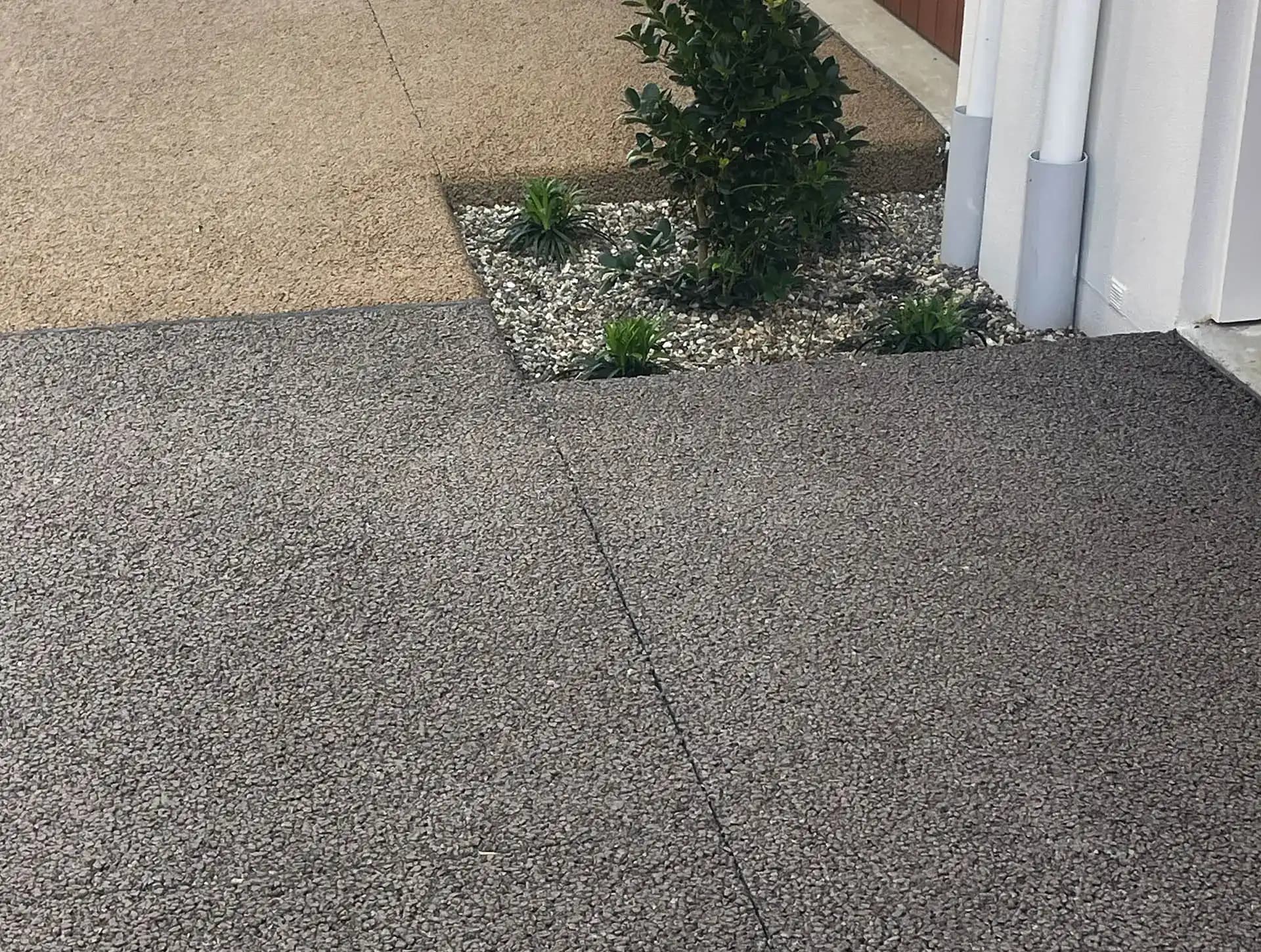
Start with how it looks. Standard Permcon shows its stone, 7 mm in Victoria and 10 mm in other states, in plain grey, charcoal, soapstone or sandstone. For a smoother surface, Ultracon uses a much finer stone with a permeable resin.
Under the colour is 125 mm of 25+ MPa concrete, poured as one continuous surface. Pavers can lift and grow weeds in the gaps; a slab without joints has nothing to lift. It holds a P4 slip rating and a design life in excess of 30 years. A 10-year structural warranty covers it.
We leave the fines out, which turns 20 to 25 per cent of the slab into connected voids. Rain passes through at 8,000 to 10,000 mm/hr. Below sits a base of clean screenings that holds the water, and it either soaks away or leaves through an under-drain.
That's why it can count toward permeable area and why it cuts the pits, pipes and detention a sealed driveway drags in. Victoria's Clause 55 guidance names pervious driveways; many councils elsewhere treat them the same way.
There are four common ways to build a permeable driveway, and all of them let rain through. The differences show up once you live with one: joints, weeds, rutting, upkeep, prams and wheelchairs, and looks.
This is what we pour: 125 mm of 25+ MPa concrete laid as one surface over a stone base. There are no joints to rock, rut or fill with weeds, and prams and wheelchairs roll across without catching an edge. The weakness is upkeep you can't skip. It needs a look each month and a sweep each year, or the voids slowly fill. Pour day needs truck access, and the open stone texture isn't for everyone (Ultracon is the smoother finish).
Open-jointed and porous concrete pavers come in plenty of shapes and colours, and a cracked one can be lifted out and replaced on its own. The joints are the catch. Weeds root in them, the joint gravel needs topping up, and if the bedding settles, pavers can sink or spread where tyres turn. Wide open joints can also snag pram and wheelchair wheels.
A plastic grid, concrete grid or geocell holds grass or gravel in place so the ground doesn't rut. It's one of the cheaper ways to make a lawn drivable, and it looks green while the grass holds up. Grass under a car parked there every day usually dies back, gravel-filled cells shed stones, and prams, wheelchairs and heels struggle on it. For a trailer spot or overflow parking, a grid is often the better fit.
Loose gravel over a compacted base is the cheapest permeable surface and the quickest to lay. On a tight budget, or for a long rural track, it's often the sensible choice, and we'll tell you so. It ruts where tyres turn, wanders onto the lawn and the street, grows weeds unless it's sprayed and needs regular raking. It's also the hardest of the four to push a pram or wheelchair across.
We price a Permcon driveway on the site in front of us. Area comes first, then access for the truck, what has to come out, how deep the base goes for your soil, and the finish you pick. What moves the cost goes through each one.
Which option fits comes down to what you park, the slope of the block, your soil and what council has asked for. Book a free site visit and we'll walk it with you.
Victorian Government housing runs a Permcon shared-driveway detail across its programme, and it's the job we pour most. That's hundreds of homes a year through most of its panel builders, all on one slab and base detail and one set of drawings. When a permit comes with a permeable-area condition, email the plan and we'll return a profile and a figure. Your engineer can check the data on our technical page.
There are four common ones: poured permeable concrete like Permcon, permeable pavers, grass or plastic grids and geocells, and loose gravel. All of them let rain through. They differ on joints, weeds, upkeep, cost and how a pram rolls across them, and each has a place. We've set them side by side under permeable driveway options compared.
Yes. We have installation teams in every state, and every driveway starts the same way: a site visit, then a slab and base designed for your soil and for what council has asked for. The one difference you'll see is the stone, 7 mm in Victoria and 10 mm in other states.
Clause 55 guidance names pervious driveways in Victoria, and councils elsewhere often accept one under their own stormwater controls. The decision belongs to your planner or drainage engineer, so we give them our infiltration and storage numbers on paper. Never a promised approval.
Normal concrete is sealed. Every drop gets pushed across it to a grate or the kerb, and in a heavy storm that's often your garage. With the fines left out, ours drains straight down through the voids described above. Strength-wise it's the same structural concrete, one surface, no joints.
Your soil is the biggest variable, because the base underneath does most of the work and its depth follows the ground. After that come area, access, what has to be removed and the finish. We price per site; see what moves the cost for the detail. The real number comes once we've stood on it.
No. Permcon carries a P4 slip rating, and because rain drains down through the surface there is no sheet of water sitting on it to slip on in the first place. The open texture gives tyres and shoes something to grip; Ultracon's smoother finish keeps the same rating.
It will if nobody looks after it. Once a month, glance at it after rain and check it's clear of leaves and draining. A yearly sweep covers most driveways. If the voids start filling, wash the surface and they open again.
That comes down to slab thickness. Just tell us at the site visit: a van sitting still for months isn't the same load as a car that comes and goes. Every job gets the same mix. For heavier vehicles we go thicker, and a 175 mm slab carries an estimated 11.3 t axle load.
The ground under your driveway moves the price more than the slab on top of it, which is why we quote after a site visit. Base depth changes from block to block, and depth costs money. Size counts too. So does truck access, and whether an old slab has to be jackhammered out and carted off before we start. Next to traditional permeable pavers, Permcon goes in up to 70 per cent faster, and the overall project usually costs less. Send an address and rough size for a real number.
Yes, with a loaded trailer on the back as well. Permcon is 25+ MPa concrete, poured over a base of clean screenings. The standard thickness is 125 mm thick and at that thickness it gets used for almost every application. The car parks we pour use that same mix, and where loads go up we go thicker rather than change it. A 10-year structural warranty covers the slab; terms and conditions apply.
No, grey is only one of them. Permcon also comes in charcoal, soapstone and sandstone. Its stone is 7 mm in Victoria and 10 mm in every other state; Ultracon uses a much finer stone for a smoother finish. Tell us the look you're after when you enquire and we'll match a finish to it.
Water heads down, into the screenings, and the base stores it. A driveway profile typically holds between 37 litres and 42 litres per square metre. Sandy ground drinks it. Clay holds it in the base while an under-drain lets it out slowly, which is usually what the council's stormwater engineer is after. We're always happy to look and review and go through it with a client.
Standing on your driveway, we look at what you park there, the fall, whether a truck fits past the letterbox, the soil, where water runs today and what council has asked for. Slab, base and figure follow from that.
The old concrete or pavers come out. In goes a clean screenings base, compacted as deep as your soil and storage target demand, with an under-drain wherever the ground won't take water.
Truck in. The mix goes down in one continuous run. Crews place 500 m² and more in a day, so your driveway is almost always done in one visit.
It stays covered while it cures and we finish the edges and thresholds. Then you get the drive-on date, along with the maintenance schedule and the warranty in writing.
Split down the middle by a black timber fence, two plain grey permeable parking pads front a contemporary home and finish at garden beds on each side.
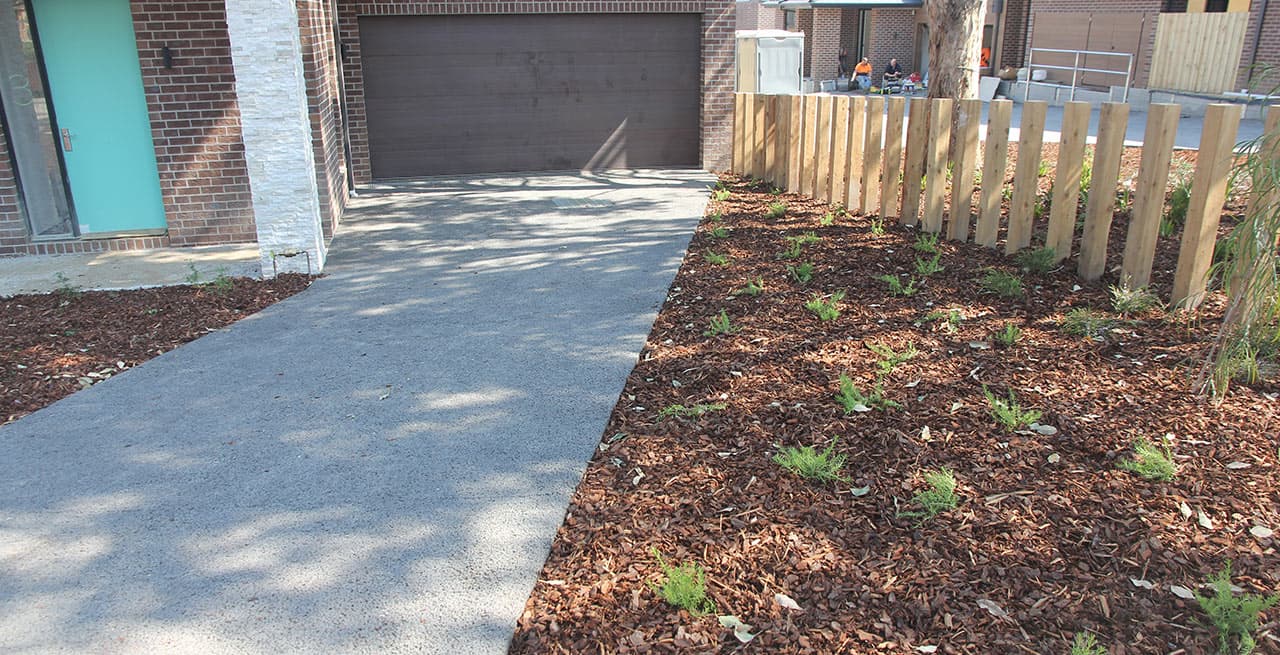
A grey Permcon driveway runs up to a brown garage door, with a mulched garden bed and timber posts along the side.
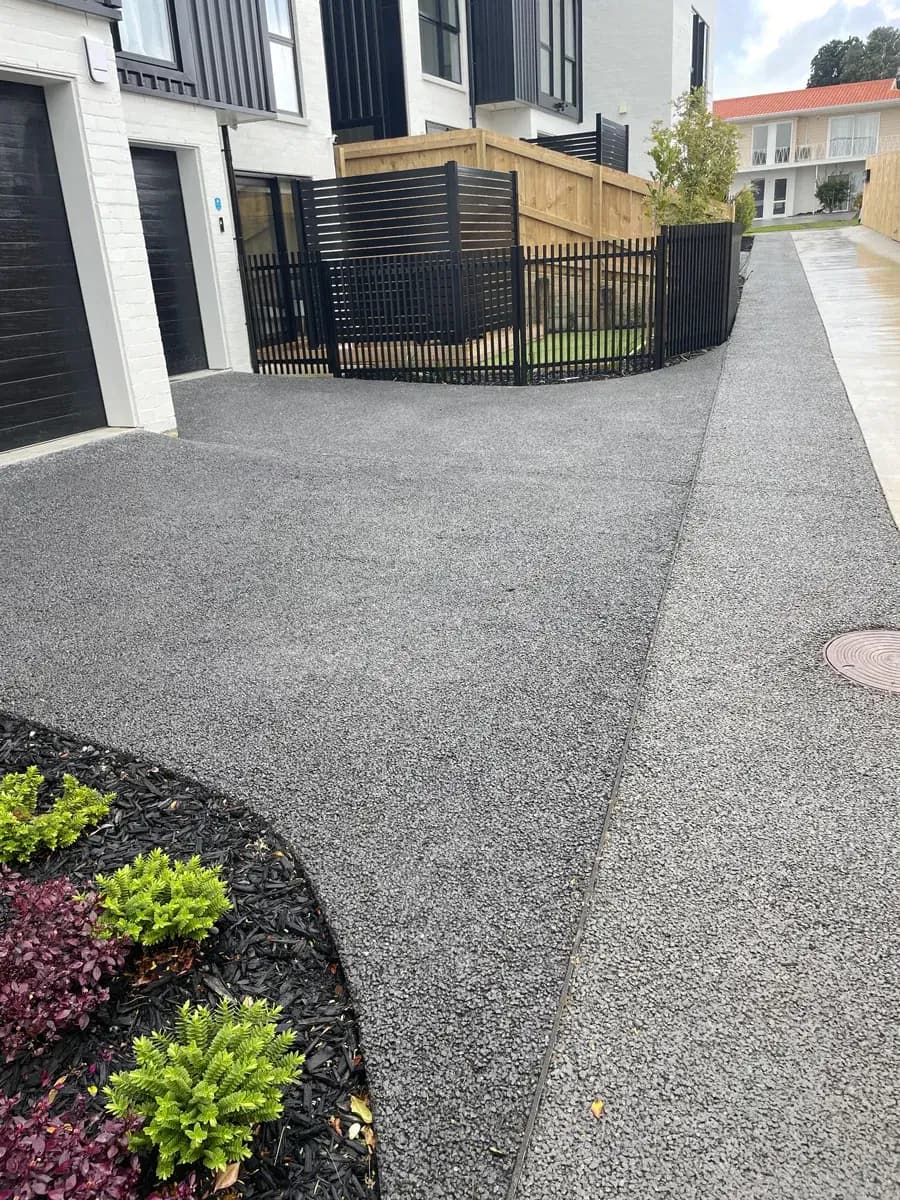
Ferns and red-leaved planting mark the bend where this dark grey Ultracon driveway curves past shared garages, its edges softened by garden beds.
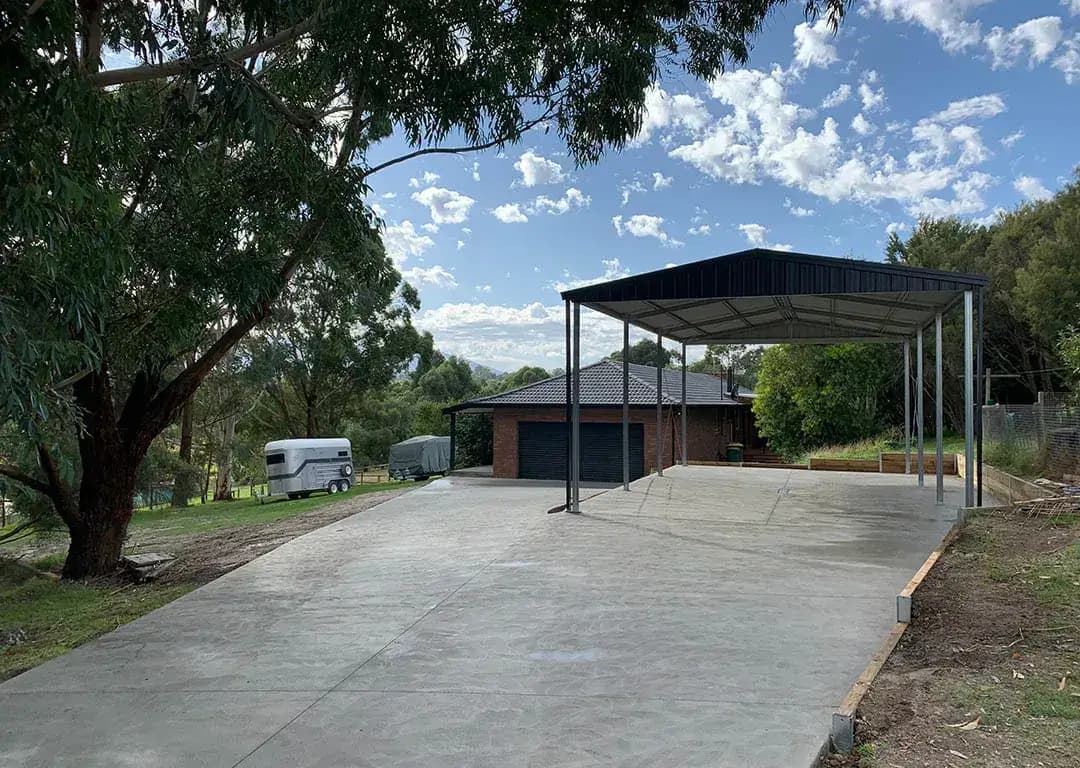
Timber boards and steel pegs still edge this long Ultracon driveway, climbing a treed block to a brick home's carport.
Permcon is Australian made, and we design it and put it down with our own crews under ISO 9001, ISO 14001 and ISO 45001. If you're parking a van or boat there, mention it when you call.