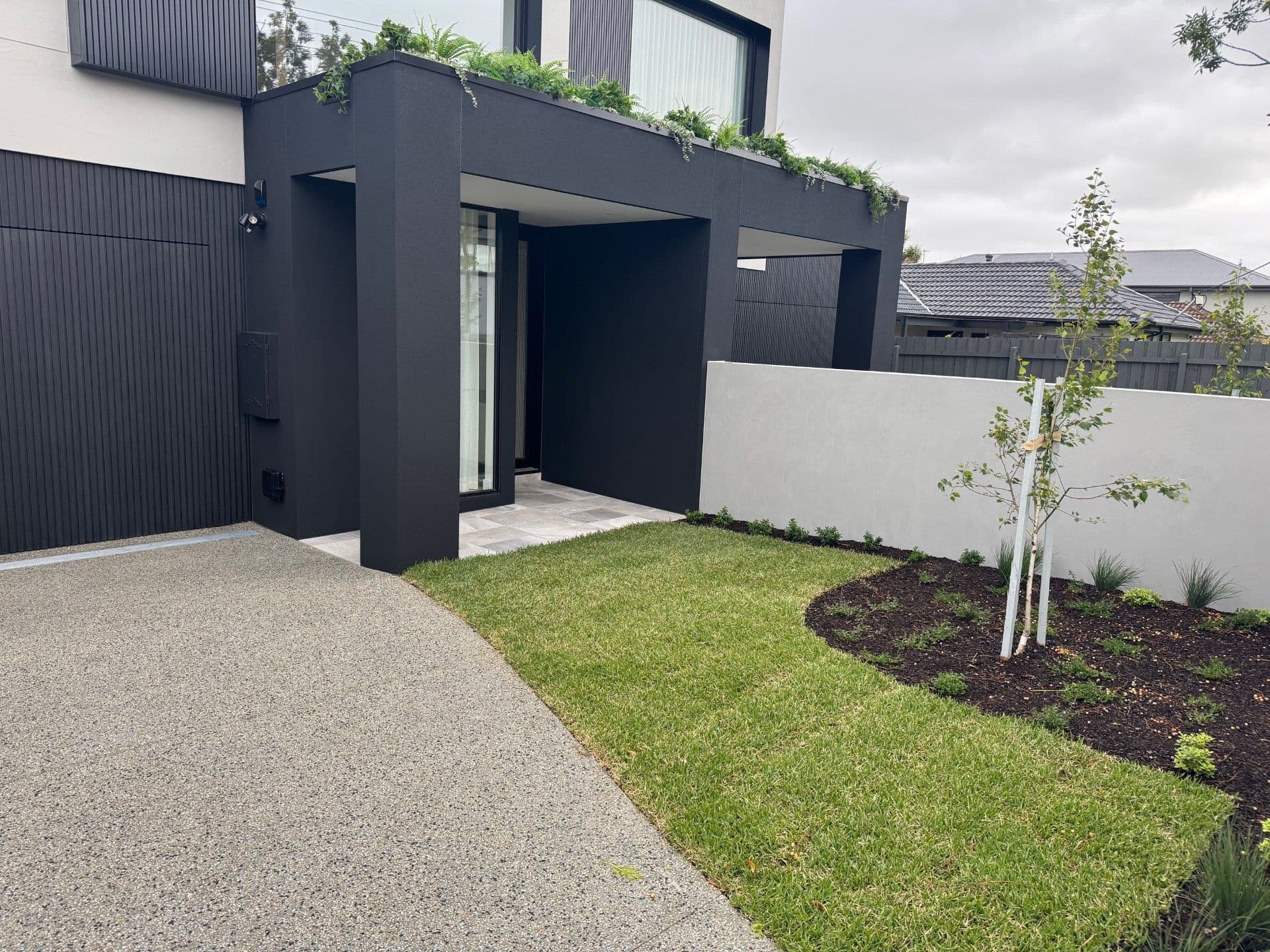
Exposed Aggregate Driveway
Start with a number: 125 mm. That's the standard thickness for a driveway slab, poured at 25+ MPa, the same strength we use under car parks. Thickness is the lever, not the mix. A caravan parked overnight or a loaded trailer reversing in doesn't change the recipe, it just decides how thick we pour.
That's not what people ask about first, though. What they ask about is the finish. It's the exposed aggregate driveway that gets specified before drainage or slab depth ever come up, the one that finishes the front of the house rather than just parking a car on it.
Why our exposed aggregate driveway drains
A standard concrete driveway gets its exposed aggregate look from a finishing step: the top layer of paste is washed back after the pour so the stone shows through a solid slab underneath. Ours skips that step, because the stone already is the surface. The mix leaves the fines out, so what sets holds a void content of 20 to 25 per cent, connected between each piece of stone.
Rain lands on it and keeps going: 8,000 to 10,000 mm/hr through the surface, into a base of clean screenings that stores it and lets it soak into the ground below. No puddle at the garage door. No sheet of water sliding down the crossover into the street.
It shows up in the details too: no joints breaking the surface into panels, one continuous pour from the garage to the kerb.
What you're choosing when you choose the finish
Aggregate size is set by geography: 7 mm in Victoria, 10 mm in every other state, both fine and even underfoot. Colours are plain grey, charcoal, soapstone and sandstone. Sandstone works with render and brick. Charcoal disappears under dark cladding.
For a finer texture, Ultracon uses 2 to 5 mm stone and drains the same way underneath.
Driveways and sports courts
The same surface goes down under sports courts, same logic: a slab strong enough for the load, permeable where it stands. The finish is one thing and the base underneath is another, so it's worth reading what actually goes into a permeable concrete driveway before you pick a size or a colour.
How it holds up under a car
There are no joints, and the surface carries a P4 slip rating, so it grips when it's wet. There's a 10-year structural warranty behind it. Maintenance is small: check it once a month, keep gum tree leaves and garden soil off the surface, sweep it once a year. If it slows down, a wash brings it back.
Tell us the size of the driveway and where the water currently runs. We'll come and have a look and give you a figure for the actual site, not an estimate over the phone.