Permeable Concrete Pavement at Lilydale Airport
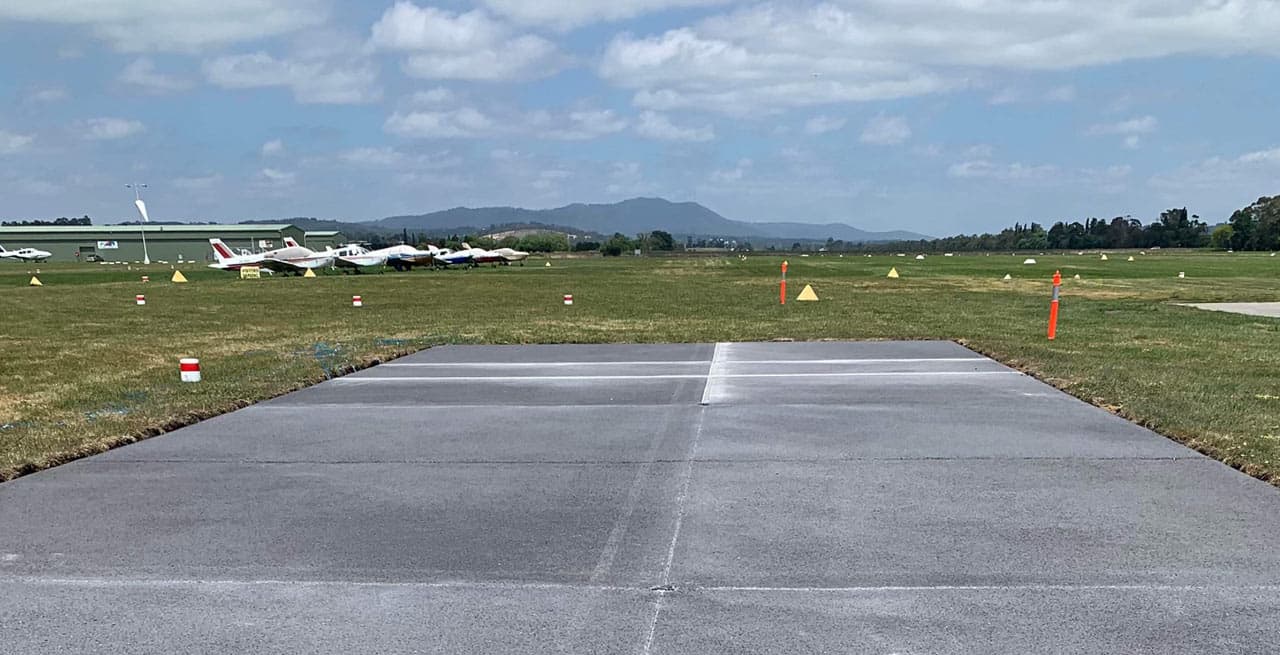
Tie-down chains bolt into the pavement under an aircraft's wings. At Lilydale Airport, that permeable concrete pavement is Ultracon, poured across a tie-down row and a hangar apron, each its own slab.
What the job needed
An apron is built dead flat so aircraft can taxi and park without fighting a slope. Flat ground ponds, though. A sealed pavement handles that with falls, pits and pipes, and low spots can still hold water long after a storm has passed.
Wet tyres and spray off a soaked apron slow turnaround near a hangar door.
What we poured
We poured a permeable concrete pavement over a base of clean screenings, one slab for the tie-down row and a second for the hangar apron. Every job runs the same mix, 25+ MPa, whatever the site. Thickness is what moves: it's pulled off our loading chart for the aircraft using that particular area, the same logic we'd use sizing a car park for the delivery trucks that use it.
Underneath, that base carries the slab and stores the rain at the same time, holding it until the ground can take it. Across a footprint the size of an apron, that's a serious volume of water, so the base depth gets worked out as part of the design, not tacked on once the slab's already planned.
How the permeable concrete pavement performs
Water passes through the surface at 8,000 to 10,000 mm/hr. Less water reaches the airfield's stormwater drains because the base is holding the storm back and letting it go slowly.
One continuous pour means no joints for wheel loads to work at, chock after chock, tow after tow. Looking after it comes down to a monthly check and an annual sweep, with a wash thrown in only if the voids start holding debris.
Permeable concrete on an airfield still surprises people who've only seen it on a driveway or a footpath. Ring us if you're weighing it up for an apron, a hangar forecourt or a hardstand, and we'll walk you through how the slab gets sized on our airport tarmac page.